
When Trash Feels Overwhelming Finding Connection Through Compost

Trash can make the future feel like a very rude group project.
You open the bin. There’s plastic. Food scraps. Packaging from something that promised to be “eco” but arrived dressed like a tiny landfill. Then you look outside and remember rivers, forests, heat, pollution, and the endless scroll of bad news.
No wonder people shut down.
Here’s my stance: we don’t need to carry the whole environmental crisis in our chest to care about the Earth. That weight will crush us. What we can carry is smaller, closer, and more honest. A banana peel. A handful of soil. A meal. A plant on the windowsill. The small piece of Earth directly in front of us.
That’s where connection starts.

The overwhelm is real, and pretending it isn’t won’t help
There’s a strange shame that can come with caring.
You care, so every piece of trash feels personal. Every plastic wrapper looks like a tiny accusation. Every environmental headline feels like a brick added to a backpack you did not ask to carry.
That emotional mix can get messy fast.
There’s guilt.
“I should do more.”
There’s helplessness.
“What difference does my compost bucket make when the world is producing mountains of waste?”
There’s anger.
“Why are systems built this way? Why is everything wrapped, shipped, tossed, and replaced?”
There’s sadness.
“This place is beautiful. Why are we treating it like a junk drawer with weather?”
And then there’s avoidance. The brain hits its limit and quietly says, “Cool, we live in denial now.” Very human. Not ideal. Still human.
The problem is that guilt is not the same as relationship. Panic is not the same as care. Doom scrolling is not a spiritual practice, even if it does involve candles, snacks, and a thousand-yard stare.
If we only relate to the Earth through crisis, we lose the ability to feel rooted. We start seeing ourselves as either heroes or failures. That’s too dramatic. Also exhausting. Nobody needs to be the main character of compost.
We need a different starting point.
Relationship comes before action
A lot of environmental advice begins with a to-do list.
Buy this. Stop that. Swap this. Never do that again. Congratulations, you are now responsible for civilization.
That approach can help in practical ways, but it can also turn care into performance. The moment you mess up, and you will, because you are a person living inside real systems, shame slides back in.
Connection works differently.
Connection asks simpler questions.
What did the Earth give me today?
What did I throw away without noticing?
What touched my life before it became “waste”?
What small act can I do without overwhelming myself?
This is not soft thinking. It’s practical. People protect what they know. People return to what they love. People keep showing up when the action is tied to relationship, not just fear.
Think about food.
Before lunch became a container, a receipt, and a crumb situation in your car, it was soil. Water. Seed. Sunlight. Fungi. Bacteria. Plant roots. Human hands. Harvest. Transport. Cooking. Eating.
That sandwich had a whole backstory. Basically a documentary with lettuce.
When we remember that, waste changes shape. The apple core is no longer “trash.” The coffee grounds are not a failure. The carrot tops are not the end of the story.
They are matter in motion.
Compost is a daily reminder that endings are not always endings
Composting is humble. It doesn’t need a cape.
It takes what looks spent and returns it to a cycle. Peels, stems, leaves, grounds, shells. The stuff we’re trained to make disappear. Compost says, “Hold on. Nature isn’t finished with that.”
That’s the lesson.
Nature transforms constantly. Leaves fall and become soil. Dead wood feeds fungi, insects, and microbes. Food scraps break down into nutrients. Microorganisms do invisible work with the confidence of tiny chefs who never asked for applause.
Composting puts that transformation where we can see it.
Not instantly. Compost is not a microwave. It’s more like a slow-cooking soup made by worms, microbes, moisture, air, and time. Weird soup. Beautiful soup. Do not eat the soup.
The point is not perfection. The point is attention.
When we compost, we stop treating waste as a magical vanishing act. Because “away” is not a place. The trash truck takes things out of sight, but not out of the world.
Compost invites us to pause before the toss.
It asks, “What is this? Where did it come from? Could it return to the Earth instead of being sealed away?”
That pause matters. It interrupts the habit of disappearance.
Gratitude is not denial. It is fuel.
Some people hear “gratitude” and think it means ignoring harm.
Nope.
Gratitude is not pretending everything is fine while the house is on fire. It’s remembering why the house matters while we figure out where the hose is.
Gratitude brings us back into relationship with the living systems that support us every day.
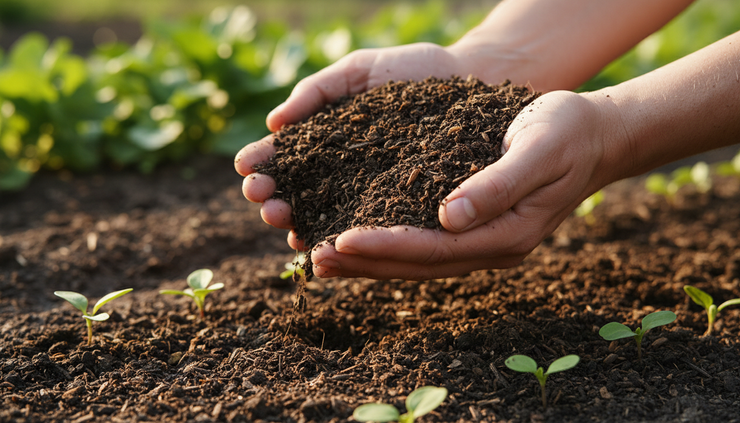
Soil holds and feeds life.
Water moves through our bodies, kitchens, gardens, clouds, and rivers.
Plants turn sunlight into food, shade, oxygen, beauty, and occasionally houseplant drama.
Microorganisms break things down and build things up. They are tiny, ancient collaborators. Also, they run a lot more of the show than our egos enjoy admitting.
The people who grow our food carry knowledge, labor, patience, and risk.
The systems of nature regenerate without a motivational podcast, a planner, or a color-coded habit tracker.
Gratitude does not erase grief. It gives grief somewhere to stand.
When we feel grateful for soil, food, water, plants, microbes, growers, and cycles, environmental care stops being only about stopping damage. It also becomes about honoring what is already giving itself to us.
That shift is huge.
Because guilt burns fast. Gratitude can keep a flame.
Treating waste with awareness changes the culture
Let’s address the big counterargument.
One person composting will not save the planet.
True.
One person composting also will not make sourdough, raise a child, clean a river, teach a language, tend a garden, or build a neighborhood on their own. Humans don’t work that way. Culture is shared practice.
Small acts become powerful when they stop being lonely.
A compost bucket in one kitchen is a habit. Compost buckets across a block are a culture. A school garden that teaches kids where banana peels go is a culture. A community that values soil is a culture. A family that pauses before tossing food scraps is a culture.
This matters because culture shapes what feels normal.
Right now, waste often feels normal. Buying too much feels normal. Throwing things “away” feels normal. Not knowing where food comes from feels normal. Being disconnected from soil feels normal.
Those norms can change.
They change through policy, infrastructure, education, farming, repair, reuse, compost access, better design, and community effort. They also change through daily rituals that remind us we belong to living systems.
Composting is one ritual.
Not the only one. Not a purity test. Not a gold star for being the best Earthling in the group chat.
It’s a practice. It says, “I’m paying attention.”

Start with the piece of Earth in front of you
The environmental crisis is too large for one nervous system.
That sentence should be printed on reusable tote bags. Tasteful ones. No guilt font.
We are not built to emotionally process every landfill, oil spill, storm, species loss, and policy failure before breakfast. Trying to do that can make us numb.
So start smaller.
Not because the crisis is small. Because relationship needs somewhere to begin.
Spend a few minutes outside. Touch soil if you can. Notice a plant. Look at the veins in a leaf. Watch ants carry something absurdly large, because ants have no chill. Pay attention to the food on your plate. Notice what you throw away today.
No fixing. No buying. No researching the perfect system until midnight.
Just noticing.
Ask one question.
What am I grateful for that came from the Earth today?
Maybe it’s coffee. Rice. Beans. Mint. Rain. A wooden spoon. Cotton socks. The apple that got bruised but still showed up for you.
Then ask another.
What do I usually call “waste”?
Food scraps? Weeds? Fallen leaves? Old stems? Time spent resting? Parts of yourself that don’t feel productive? Careful, compost gets philosophical fast.
Then ask this.
What would change if I saw waste as part of a cycle instead of an ending?
You may not find a tidy answer. Good. Tidy answers are suspicious. Life is compost, not a spreadsheet.
The point is to practice seeing.
Compost gives action a shape we can actually hold
Action does not have to begin with panic.
It can begin with a bowl on the counter.
It can begin with learning what food scraps your compost system accepts. It can begin with saving coffee grounds. It can begin with dropping scraps at a local compost site, starting a backyard pile, joining a community program, or simply separating organics from trash for the first time.
It can begin with noticing how much edible food gets tossed before it becomes scraps.
It can begin with cooking the broccoli stems. Bold. Crunchy. Slightly smug.
Composting gives care a physical rhythm.
Collect. Notice. Return. Repeat.
That rhythm teaches the body something the news cannot teach by itself. It teaches that transformation is real. It teaches that decay is not always failure. It teaches that what we call useless may still feed life.
If you want tools, composting products, or support for building the habit, explore Compost Cultura’s compost offerings. Start small. Start where your real life is.
And today, do the simplest thing first.
Spend 5 minutes outside. Don’t fix anything. Don’t buy anything. Don’t turn it into content. Just observe.
Let the Earth exist without needing to prove its usefulness.
That may sound tiny.
Tiny is where roots begin.
FAQ
Do my composting habits really matter if big systems create most waste?
Yes, but not because your banana peel will single-handedly rescue Earth like a tiny yellow superhero. Your habit matters because it changes your relationship with waste. It also helps build a culture where composting, repair, reuse, and soil care feel normal.
What if I feel too overwhelmed to start composting?
Start with noticing. Spend one day paying attention to what you throw away. No judgment. After that, choose one easy scrap to separate, like coffee grounds or vegetable peels. Small counts.
Is composting more spiritual or practical?
It can be both. Practically, composting returns organic matter to a natural cycle. Spiritually, it reminds us that transformation is always happening, even when we can’t see it.
What if I don’t have a yard?
You can still build awareness. Look for community compost drop-offs, local collection services, indoor compost options, or shared garden programs. If none of that works right now, begin by reducing food waste and noticing what you throw away.
How do I avoid turning this into another guilt project?
Keep it simple. Pick one practice you can repeat. Don’t aim for perfect. Aim for honest attention. Compost is a relationship, not a moral obstacle course.

The trash may still feel overwhelming tomorrow. The headlines may still be heavy. The systems may still need serious change.
But you don’t have to hold the whole thing at once.
Hold a handful of soil. Notice the meal in front of you. Save the peel. Thank the growers. Watch a plant keep going like it knows something.
Then take one small action that brings you back into relationship with the living world.
That’s not everything.
It’s enough to begin.


Comments