
Less but Better Rethinking Consumption Happiness and Our Responsibility to Earth

The greenest thing we can do is often the thing we don’t buy.
That sounds annoying at first. Very unfun. Like a tiny environmental accountant living in your shopping cart, tapping a clipboard.
But it’s true.
We all participate in consumer culture. We buy groceries, clothes, phone chargers, cleaning supplies, gifts, coffee cups, replacement socks, and that one kitchen gadget that promised to change our lives but now lives in a drawer with the twist ties.
No shame. Seriously. Shame is useless compost. It doesn’t grow much.
The point isn’t to pretend we live outside the system. We don’t. The point is to become more awake inside it. Meaningful environmental change starts before the trash can, before the recycling bin, before the compost bucket. It starts at the moment we ask, “Do I actually need this?”

We all swim in the same shopping soup
Consumer culture isn’t just “people buying too much stuff.” That’s too easy. It’s bigger than that.
It’s the air around us.
We’re surrounded by messages that say a better life is one purchase away. A new outfit will make us confident. A new phone will make us productive. A new couch will make us relaxed. A new water bottle will finally turn us into a hydrated, glowing woodland creature with perfect boundaries.
Advertising doesn’t only sell products. It sells a feeling.
It says:
You’ll be happier when you upgrade.
You’ll be more beautiful when you fix this.
You’ll be more successful when you own that.
You’ll be more comfortable when you replace what still works.
You’ll be more fulfilled when the delivery truck visits again.
That’s a powerful story. It works because we’re human. We want comfort. We want belonging. We want beauty. We want ease. We want a life that feels good.
Buying things can meet real needs. A warm coat matters. A working fridge matters. A safe car seat matters. A tool that helps you do your job matters.
The problem begins when every feeling gets translated into a shopping list.
Bored? Buy something.
Sad? Buy something.
Stressed? Buy something.
Celebrating? Buy something.
Existing after 9 p.m. with access to one-click checkout? Dangerous territory. Hide the credit card and back away from the novelty lamp.
Want and need are not the same animal
“I want it” is not wrong.
Wanting is part of being alive. We want color, softness, flavor, music, comfort, beauty, play. A life without desire would be bleak. Very beige. Probably fluorescent-lit.
But “I want it” and “I need it” are different questions.
A need supports life, health, safety, dignity, connection, or meaningful function. A want may still matter, but it deserves a pause.
That pause is powerful.
Before buying something, ask:
Will I use this often?
Do I already own something that does the job?
Can I borrow it?
Can I repair what I have?
Can I buy it secondhand?
Will this still matter to me in a month?
Is this filling a real need, or feeding a mood?
That last one stings a little. It’s also where the magic lives.
Sometimes the answer is, “Yes, this will genuinely add value to my life.” Great. Buy the thing. Use it. Care for it. Don’t feel guilty.
Sometimes the answer is, “I’m tired, overstimulated, and being personally bullied by an algorithm.” In that case, close the tab. Drink water. Go outside. Text a friend. Rejoin the mammals.
The goal is not to kill joy. The goal is to stop confusing purchase with purpose.
More stuff creates more than clutter
Every item has a backstory.
Before something reaches a shelf or a front porch, it has already passed through a long chain of impact. Even the small things. Even the cute things. Especially the cute things, because cute things are sneaky.
Excessive consumption creates more:
Manufacturing
Products require factories, labor, machinery, and materials.
Packaging
A tiny object can arrive wrapped like it’s a royal artifact. Plastic film, foam, cardboard, tape, inserts, packets, labels. The packaging sometimes has more drama than the product.
Transportation
Goods move by ship, truck, plane, train, and delivery van before reaching us.
Resource extraction
Metals, fibers, fossil fuels, timber, water, and minerals come from somewhere. The Earth is not an endless supply closet.
Energy use
Production, storage, shipping, and disposal all require energy.
Waste
Some waste is visible. Some is hidden upstream, created long before we open the box.
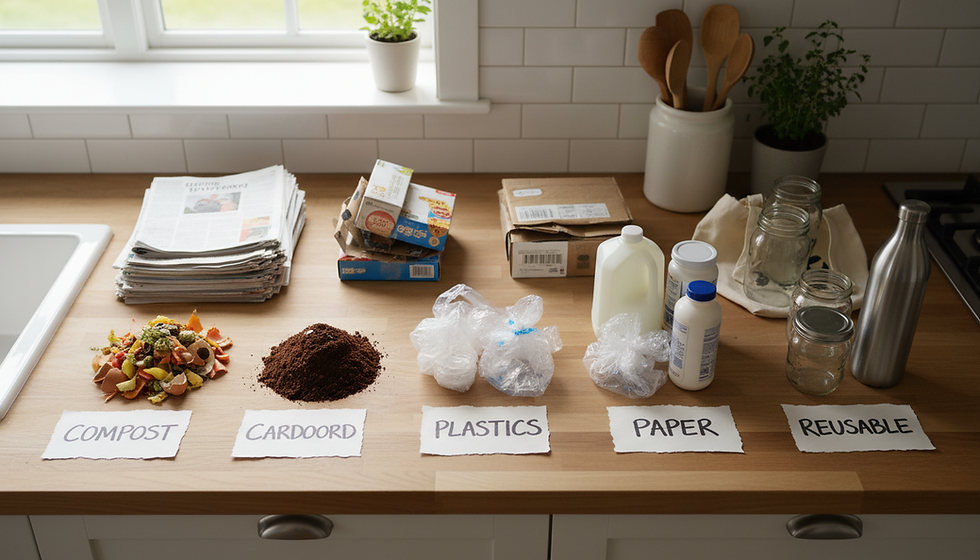
Recycling matters. Composting matters. Reuse matters. They’re part of a healthier system.
But the cleanest waste stream is the one we never create.
That doesn’t sound glamorous. Nobody throws a parade because you didn’t buy a decorative plastic pumpkin in July. But prevention is powerful. Avoided waste doesn’t need to be sorted, hauled, melted, pulped, landfilled, composted, or wished into a better afterlife.
It never enters the system.
That’s a win.

Recycling is good, but prevention is better
Let’s give recycling and composting their flowers.
Recycling can keep materials in use. Composting can turn food scraps and yard waste into rich soil. These practices help us see waste as a resource instead of a dead end. Compost Cultura is built around that exact shift in thinking.
Still, we can’t recycle our way out of endless consumption.
Recycling systems have limits. Some materials degrade. Some items are mixed with coatings, dyes, adhesives, or plastics that make them hard to process. Some things never make it into the right bin. Some get contaminated. Some get shipped around like confused luggage.
Composting has limits too. It can handle banana peels, coffee grounds, leaves, and food scraps. It cannot compost impulse buys, broken electronics, fast-fashion regret, or the emotional damage caused by tangled holiday lights.
Managing waste better matters.
Creating less waste matters more.
That means looking upstream. Not only at what leaves our homes, but at what enters them. Every purchase is a vote for more of something. More extraction. More production. More packaging. More transport. More eventual disposal.
That sounds heavy, so let’s bring it back to normal life.
Buying less doesn’t mean living in an empty white room with one wooden spoon and a suspiciously peaceful linen shirt. It means choosing with care.
Less but better is practical, not precious
“Less but better” can sound fancy, like something whispered in a minimalist furniture store where one chair costs more than a used car.
Forget that.
Less but better is common sense with a backbone.
It means buying fewer things, and expecting more from the things we do buy. It means caring about usefulness, durability, repair, and joy. It means stepping off the treadmill of constant replacement.
Try this version:
Buy fewer things.
Buy things that last.
Repair instead of replace.
Reuse what you already own.
Borrow and share when possible.
Buy secondhand.
Support local makers and businesses.
Ask whether the purchase will genuinely add value to your life.
This isn’t about being fancy. It’s about being free.
A cheap item that breaks after three uses isn’t cheap. It’s a rental with a trash fee.
A closet full of clothes you don’t wear isn’t abundance. It’s laundry with commitment issues.
A garage packed with “just in case” items can quietly become a museum of forgotten intentions. Admission is free, but you can’t park your car.
Less but better gives us breathing room. It asks, “What deserves space in my life?”
That question matters because space is not only physical. It’s mental. It’s emotional. Every object asks something from us. Clean me. Store me. Move me. Fix me. Remember me. Feel bad about not using me.
Stuff can be useful. Stuff can be beautiful. Stuff can also be loud.
Taking responsibility is not the same as taking blame
Here’s where people get stuck.
Talk about personal responsibility, and someone says, “But corporations create huge amounts of pollution.” True.
Talk about industry impact, and someone says, “But individual choices still matter.” Also true.
We don’t need to pick one.
Large systems need large changes. Companies, governments, supply chains, and policies must change. That’s real. Individual consumers cannot carry the whole planet on their tote bags, no matter how sturdy the stitching is.
At the same time, our daily choices shape demand, habits, culture, and waste. They influence what gets made, sold, normalized, and expected.
Responsibility is not blame.
Blame says, “This is all your fault.”
Responsibility says, “You have a role to play.”
Those are very different energies.
Blame freezes people. Responsibility wakes people up.
We don’t have to become perfect environmentalists. Perfect environmentalism is a myth, and honestly, it sounds exhausting. Someone would eventually argue about the carbon footprint of the halo.
We do need to become conscious participants.
That means paying attention. It means changing what we can. It means refusing to use imperfection as an excuse to do nothing.
A repaired jacket counts.
A borrowed drill counts.
A secondhand table counts.
A skipped impulse purchase counts.
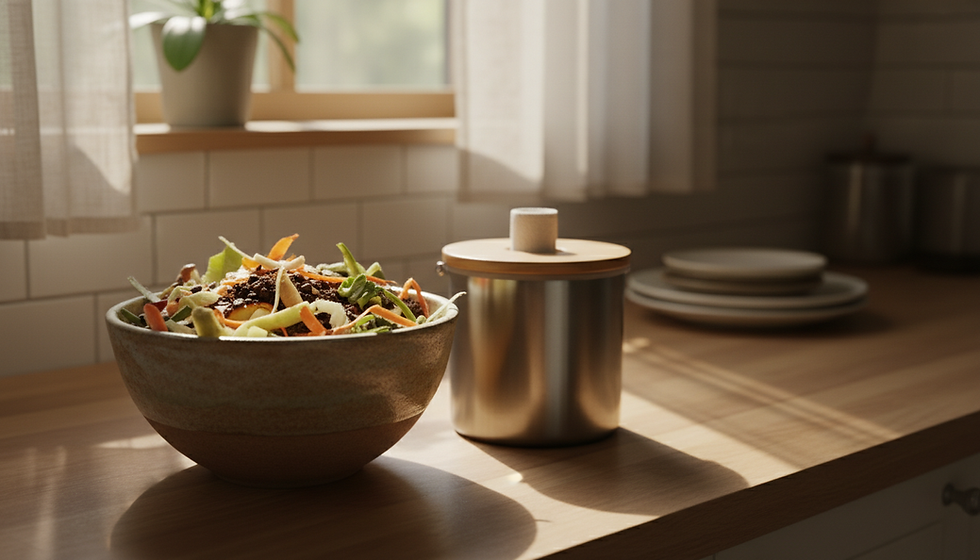
A compost bucket counts.
A conversation with a neighbor counts.
Small choices don’t solve everything alone. They help build a culture where waste is questioned instead of accepted as normal.

Choosing less can give us more
The wild thing about buying less is that it doesn’t always feel like sacrifice.
Sometimes it feels like relief.
Less shopping can mean more time. Fewer returns. Fewer decisions. Fewer mystery cords in drawers. Fewer Saturday afternoons spent wandering a big store under lights bright enough to interrogate a sandwich.
Choosing less can create room for things that don’t come in packaging:
Time
Creativity
Relationships
Nature
Community
Experiences
Art
Movement
Rest
Gratitude
These are not consolation prizes. They are the good stuff.
A walk with a friend can outlast the thrill of a new purchase. Cooking with what’s already in the fridge can feel better than ordering more. Repairing something can make it more meaningful. Borrowing from a neighbor can turn an object into a relationship.
Even boredom has value. Boredom is where creativity starts stretching its legs.
Consumer culture tells us every empty space needs to be filled. Empty closet? Fill it. Empty wall? Fill it. Empty afternoon? Fill it. Empty feeling? Definitely fill it, and make sure shipping is free.
But empty space can be healthy.
It can hold rest.
It can hold attention.
It can hold the life we claim we’re too busy to live.
The Earth does not need our perfection
The Earth needs fewer extraction-to-trash pipelines. It needs healthier soil. Cleaner water. Less pollution. Stronger local systems. Better product design. More repair. More reuse. More respect for limits.
That sounds big because it is big.
But big change has a personal doorway.
Before we toss something, we can ask where it came from. Before we recycle the box, we can ask why the box entered our lives. Before we compost the scraps, we can ask how to waste less food next week. Before we buy the shiny thing, we can ask what we’re hoping it will fix.
This is where Compost Cultura’s deeper message comes in.
The goal isn’t simply to manage our waste better. Better bins help. Better habits help. Composting helps. Recycling helps.
The deeper work is to question why we create so much waste in the first place.
That question changes everything.

Start with the next purchase
Don’t try to overhaul your whole life by Tuesday. That’s how people end up rage-buying storage bins for the storage bins.
Start with the next purchase.
Pause for ten seconds. Ask the simple question: “Do I need this, or did someone convince me I’m incomplete without it?”
If you need it, choose well when you can. If you don’t, let it go. Enjoy the quiet little victory of not bringing another object into your home, your budget, and eventually your waste stream.
Less but better is not about deprivation. It’s about attention. It’s about choosing what belongs. It’s about remembering that happiness does not require a constant parade of new stuff.
We can still enjoy beautiful things. We can still buy what we need. We can still live full, colorful, generous lives.
We just don’t need more stuff to prove it.

Comments